

Thermodynamics
Thermodynamics is a foundational engineering course in which macroscopic systems are analyzed in terms of energy, matter, property changes and equilibrium states. In this context, pure substance behavior, ideal and real gas models, mass-energy balances in closed and open systems, first and second laws, entropy, exergy, power and cooling cycles are discussed together with engineering applications.
Course Content
ChaptersThe concepts of thermodynamic system, environment, boundary, property, state, equilibrium, process and cycle are discussed. Intensive and diffuse properties, phase changes, process diagrams, basic quantities such as pressure, temperature and specific volume are examined in their physical meaning. In this section, the right system selection and problem modeling approach in thermodynamic problems are emphasized.
The concept of pure substance, phase change, saturated liquid-vapor mixture, superheated vapor and compressed liquid regions are examined. Phase behavior is interpreted through P–v, T–v and P–T diagrams. The use of thermodynamic property tables, quality calculation, interpolation and selection of the appropriate table region are studied through worked examples and problem solving.
The ideal gas model, ideal gas equation of state and the concept of gas constant are discussed. The validity limits of the ideal gas approach are debated; Real gas behavior is examined through the compressibility factor and generalized compressibility diagrams. Pressure, temperature and specific volume relationships are interpreted in real gas problems using the Nelson–Obert diagram.
Energy concept. It is examined through internal energy, kinetic energy, potential energy, heat and work interactions. Energy balance is established using the first law of thermodynamics. Sign convention and physical meaning of energy interactions such as boundary work, shaft work, electrical work and heat transfer are addressed through worked examples and problem solving.
In closed systems, energy balance is applied by assuming the mass is constant. Constant volume, constant pressure, isothermal, adiabatic and polytropic processes are examined through worked examples and problem solving. Phase changes and energy transitions in closed systems are interpreted using moving boundary work, ideal gas processes and pure substance tables.
Using the control volume approach, mass and energy balance is established in open systems operating at steady state. Engineering elements such as steady-flow turbine, compressor, pump, nozzle, diffuser, mixing chamber, heat exchanger and throttling valve are examined. Flow work, enthalpy, total enthalpy, kinetic and potential energy contributions are studied by solving the steady-flow energy equation problem.
In time-dependent open systems, transient (transient) regime analysis is performed by taking into account mass and energy accumulation. Filling and emptying tanks, rigid containers, flows entering and leaving the control volume, and time-varying state quantities are examined. In this section, the ability to establish time-dependent mass and energy balance is developed through worked examples and problem solving.
The second law of thermodynamics is discussed through heat engines, cooling machines and heat pumps. Kelvin–Planck and Clausius expressions, reversible and irreversible processes, thermal efficiency, coefficient of performance and the Carnot cycle are examined. In this section, energy quality and process feasibility are interpreted physically.
The concept of entropy is explained by relating it to reversible heat transfer and the second law. Entropy change, isentropic processes, entropy balance and entropy production for pure substances and ideal gases are examined through worked examples and problem solving. The impact of irreversibilities on entropy production and the interpretation of processes in terms of the second law are emphasized.
The concept of exergy is discussed in terms of usable energy and the potential to reach equilibrium with the environment. Exergy balance, irreversibility, exergy destruction and second law efficiency are examined for the closed system and control volume. In engineering systems, the evaluation of losses not only by the amount of energy but also by the quality of energy is studied through worked examples and problem solving.
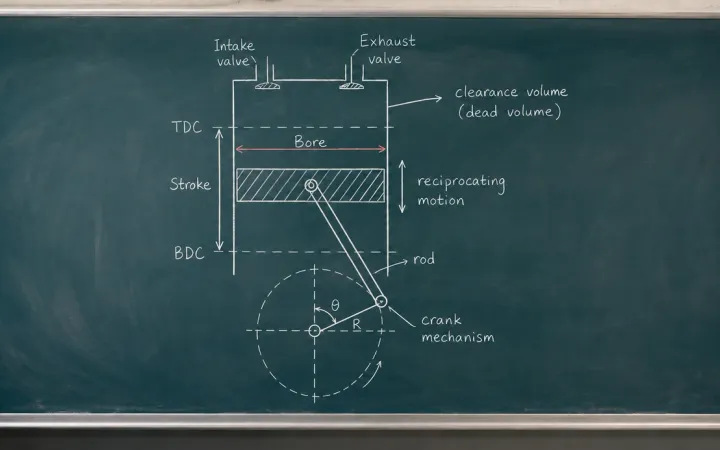
Closed system based power cycles and internal combustion engine cycles are examined. In ideal cycles such as Otto, Diesel, Dual and Stirling, compression ratio, heat input, heat output, net work and thermal efficiency calculations are made. Physical interpretation and performance comparison of the cycles through P–v and T–s diagrams are discussed.
Gas turbine based power cycles are examined through the Brayton cycle. Open system energy balances are established for the compressor, combustion chamber and turbine elements, and the net work, heat input, thermal efficiency and pressure ratio effects are calculated. Cycle improvement methods such as ideal and real Brayton cycle, isentropic efficiencies, regeneration, intercooling and reheating are interpreted with T–s diagrams.
Steam power systems are handled through the Rankine cycle. Open system energy balances are established for pump, boiler, turbine and condenser elements and turbine work, pump work, heat input, heat rejection and cycle efficiency are calculated. Methods to increase cycle efficiency through ideal and real Rankine cycle, superheating, intermediate heating, cascade turbine applications and on/off feed water heaters are examined.
Vapor compression refrigeration cycle and heat pump systems are examined with an open system approach. Cooling capacity, compressor work and performance coefficient are calculated by establishing energy balances for the compressor, condenser, throttling valve and evaporator elements. Ideal and real refrigeration cycles, P–h and T–s diagrams, special cycle models such as superheating, subcooling, multistage compression, flash chamber and cascade cooling are discussed through worked examples and problem solving.
Ideal gas mixtures are discussed with the concepts of mole fraction, mass fraction, partial pressure and partial volume. Dalton and Amagat approaches, mixture gas constant, internal energy, enthalpy and entropy properties of the mixture are examined. The property calculation of gas mixtures and the use of mixture models in engineering problems are studied.
The concepts of humid air properties, relative humidity, specific humidity, dew point temperature, wet bulb temperature and enthalpy are discussed. Heating, cooling, humidification, dehumidification and mixing processes are examined using the psychrometric diagram. In air conditioning problems, the approach to establishing mass and energy balance is studied through worked examples and problem solving.
Combustion reactions, fuel-air ratio, stoichiometric air amount, excess air, equivalence ratio and combustion products are examined. In open systems, energy balance is established for combustion. The concepts of formation enthalpy, combustion enthalpy and adiabatic flame temperature are discussed. Chemical equation balancing and use of thermodynamic properties are studied in combustion problems.
The concept of chemical equilibrium is examined in relation to reaction direction, equilibrium constant and Gibbs free energy. Equilibrium composition, the effect of temperature on equilibrium, and the thermodynamic feasibility of chemical reactions are discussed. This chapter focuses on the engineering interpretation of the equilibrium approach in combustion and high temperature gas mixtures.
Basic concepts of compressible flow; Mach number, speed of sound, stopping properties and isentropic flow relationships are examined. In nozzles and diffusers, flow behavior, choking, pressure-temperature-speed changes and a connection with the energy equation are established. This section shows how the thermodynamic background is transferred to gas dynamics problems.
Targeted Learning Outcomes
- Interpreting the concepts of thermodynamic system, property, state, equilibrium and process in their physical sense.
- Use pure substance tables, phase diagrams and ideal/real gas models correctly in engineering problems.
- To develop the ability to establish mass and energy balance in closed systems, open systems and time-dependent systems.
- To understand the concepts of second law, entropy and exergy not only at the formula level, but also through the interpretation of irreversibility and efficiency
- Analyze power, cooling, heat pump and internal combustion engine cycles with thermodynamic performance criteria
- Choose the appropriate thermodynamic model for gas mixtures, air conditioning, combustion and compressible flow entry problems.