

Physics II
Physics II support. It covers electric field, electric potential, electric circuits, magnetism, induction and electromagnetic waves.
Course Content
ChaptersElectric charge, charge conservation, conductor-insulator separation, Coulomb's law and electrostatic force interactions between point charges are discussed. In point load systems, the direction and magnitude of the force, separation into vector components, the principle of superposition and the calculation of the net force acting on a load are studied. Additionally, the concept of electric field is introduced and the physical interpretation of field lines of point charges is emphasized.
The electric field created by point charges at a point in space and the electric field contributions of continuous charge distributions are examined. Electric field vector, field lines, superposition principle, linear/surface/volumetric charge distributions and use of symmetry are studied together with worked examples and problem solving. In this section, the aim is for the student to divide the continuous charge distribution into differential load elements, collect the field contribution of each element by integration, and interpret the total electric field as a vector.
Electric flux, the concept of a closed surface, that is, a Gauss surface, and the physical meaning of Gauss' law are explained. Emphasis is placed on the selection of the appropriate Gaussian surface and electric field calculation for charge distributions with spherical, cylindrical and planar symmetry. In addition, how the electric field in conductor and insulator objects, in the inner and outer regions of the object, is determined by Gauss' law is examined. In this context, the concept of Faraday cage is also mentioned.
Electric potential, potential difference, electrical potential energy and field-potential relationship are discussed. Potential calculations for point charges and charge distributions, equipotential surfaces and obtaining the electric field from the given electric potential equation are studied.
The concept of capacitance, parallel plate capacitors and how the capacitance value changes with the plate area, the distance between the plates and the electrical permittivity of the dielectric material are examined. Series-parallel capacitor connections, equivalent capacitance calculation and electrical energy stored in capacitors are discussed with worked examples and problem solving. Additionally, the effect of dielectric materials on electric field, potential difference, capacitance and energy storage is interpreted physically.
The concepts of electric current, current density, resistance, resistivity, Ohm's law and electrical power are studied. In simple circuits, current-voltage relationship, energy conversion and series-parallel connection of resistors are emphasized.
Multi-loop direct current circuits are analyzed using Kirchhoff's current and voltage laws. Establishing node and perimeter equations, signal selection, battery-resistor systems and circuit solution strategies are studied systematically.
The mathematical model governing the charging and discharging processes in RC circuits fed by a direct current source is derived and physically interpreted. Time constant, capacitor voltage, voltage on the resistor and the change of current with time are considered within the framework of exponential behavior. The charging/discharging process of the capacitor, the calculation of the current in the circuit as a function of time, and the initial-final state behaviors are examined through problem solutions.
The concept of magnetic field and its lines, the magnetic force acting on moving charges and the physical meaning of the Lorentz force are discussed. The right hand rule, the direction of the force, the circular and helical motion of charged particles in a uniform magnetic field are examined through worked examples and problem solving. Additionally, the concepts of magnetic force and magnetic torque acting on current-carrying conductors are introduced.
The magnetic field created by current-carrying conductors is calculated using the Biot–Savart law and Ampere's law. The physical basis of the Biot–Savart law, the magnetic field contribution of the differential current element and the summation of these contributions by integration are discussed. The direction, magnitude and physical interpretation of the magnetic field in straight wire, ring, solenoid, toroid and symmetric current distributions are examined. In appropriate cases, more practical solutions are shown with Ampere's law.
The direction of the induction current is explained using magnetic flux, Faraday's induction law and Lenz's law. How changing magnetic fields, moving conductors and rotating conductive ring/coil systems can produce current is examined through worked examples and problem solving. In this context, the basic physical principles of electromechanical systems such as electric generators are introduced. The physical interpretation of the induction phenomenon is discussed with the energy conservation approach.
The concepts of self-inductance and mutual inductance are discussed in relation to Faraday's law. The behavior of the inductor against current change, energy storage in the magnetic field, and the physical meaning of mutual induction between two circuits are examined. Transient behavior in RL, LC and RLC circuits fed by direct current source; Problem solving is studied through differential equation setup, initial conditions, time constant, natural frequency, damping effect and time-dependent variation of current/voltages.
Phasor approach, impedance, reactance, RMS values and power concepts in AC circuits are studied. The behavior of R, L, C elements under alternating current, series RLC circuits, resonance and phase difference interpretations are discussed.
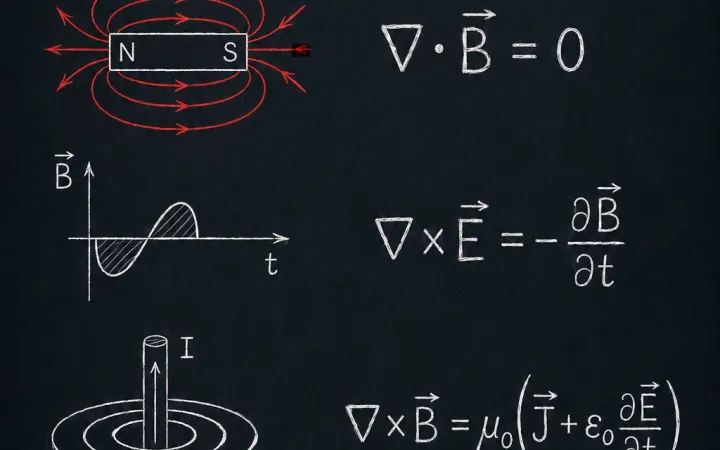
The basic physical meaning of Maxwell's equations, displacement current and electromagnetic wave formation are examined. Perpendicularity of electric field, magnetic field and propagation direction to each other; Direction determination through the amplitude relationship of the fields and the right hand rule is discussed. The speed of the electromagnetic wave, energy transport, Poynting vector and wave intensity expressions are derived and studied together with worked examples and problem solving and physical interpretation.
Targeted Learning Outcomes
- Students taking Physics II / Electricity and Magnetism courses at undergraduate-level
- Those looking for conceptual support on electric field, potential, Gauss law and circuit equations
- Those who want to improve their worked examples and problem solving skills on magnetic field, Lorentz force, induction and electromagnetic waves.
- Those who want to gather topics, interpret formulas and solve systematic questions before midterm and final exams.