

Mechanical Vibrations
Mechanical Vibrations is a foundational engineering course that deals with free, damped and forced vibrations of mechanical systems (discrete systems) through mathematical modeling, differential equation solution, frequency response, vibration isolation, dynamic vibration absorbers, modal analysis and critical speed problems.
Course Content
ChaptersThe physical meaning of vibration movement, the causes of vibration in mechanical systems and its importance in engineering design are discussed. The concepts of periodic motion, harmonic motion, amplitude, frequency, angular frequency, period, phase angle and initial conditions are examined. The general structure of the differential equations governing vibrational motion, the homogeneous solution, the special solution and the final equation of motion are discussed conceptually.
The mathematical model of discrete systems with a single degree of freedom is obtained using Newton's laws and moment equations. The equation of motion is established in basic systems including mass-spring system, simple pendulum, physical pendulum and equivalent spring coefficient. Using the natural frequency, period, initial conditions and obtaining the undamped free vibration response is studied by worked examples and problem solving.
Energy approach to vibration problems. It is discussed through kinetic energy, potential energy and energy conservation. In systems involving mass-spring systems, physical pendulums and rolling without slipping, natural frequency calculations are made using the concepts of equivalent mass, equivalent moment of inertia and equivalent stiffness. In this section, modeling skills are developed by comparing the Newtonian approach with the energy approach.
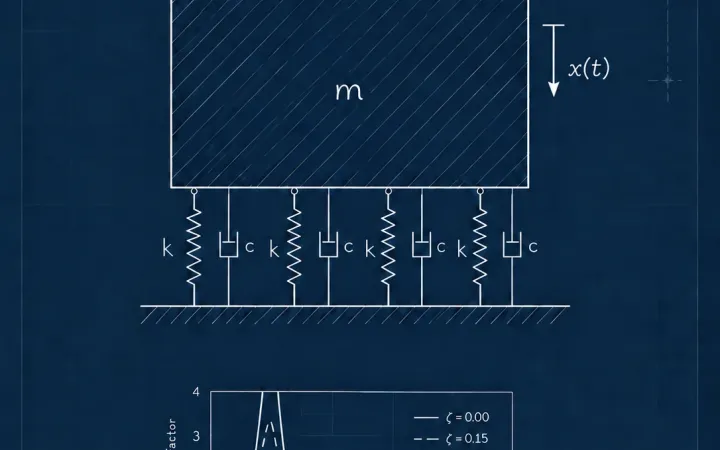
The concept of damping is examined through the dashpot model and viscous damping force. By obtaining the second order equation of motion, critical damping, underdamped, critically damped and overdamped system behaviors are interpreted physically. Damping ratio, damped natural frequency, logarithmic reduction and obtaining the equation of motion from initial conditions are studied through worked examples and problem solving.
In damped vibration systems, the roots of the characteristic equation are interpreted in the complex plane. The position of the roots in the Re–Im plane is associated with the growth, decay or oscillatory behavior of the system response. The connection between natural frequency, damping ratio, time response and stability is discussed through engineering interpretation. This chapter limits stability analysis to a fundamental level and in relation to the physical response of vibration systems.
Forced vibration under harmonic external force is examined in single degree of freedom systems. Transient and steady-state regime responses are obtained through the solution of the non-homogeneous differential equation. The effect of frequency ratio, dynamic amplification factor, phase difference, resonance and damping on resonance is studied by worked examples and problem solving. In this section, frequency response is interpreted from a mechanical system design perspective.
Different types of excitation in forced vibration are studied through engineering applications. Equations of motion are established for rotating unbalance, base excitation and transmitted force problems. Force transmissibility, displacement transmissibility, resonance region and operating frequency selection are addressed by worked examples and problem solving. Vibration isolation. It is evaluated in order to reduce the force transmitted to the ground or the movement transferred from the ground to the system. Isolator stiffness, damping, frequency ratio, transmissibility and isolation region are interpreted in terms of engineering design.
In systems with two degrees of freedom, the equations of motion are established in matrix form. Mass and stiffness matrices, natural frequencies, mode shapes and modal coordinates are examined at a basic level. Coupled motion, the physical meaning of the modes, and the interpretation of the system response through modal components are studied through worked examples and problem solving. The dynamic vibration absorber is treated as a second mass-spring system added to the main system; Target frequency setting, resonance division and reduction of main system vibration amplitude are examined with a two-degree-of-freedom system approach.
In multi-degree of freedom systems, free and forced vibration problems are addressed with the matrix approach. The concepts of eigenvalue problem, natural frequencies, mode shapes, modal orthogonality and modal superposition are examined. The role of the modal analysis approach in vibration design and resonance risk assessment in simple structure, machine and chassis models is interpreted.
Whirling motion in rotating shafts is examined through the concepts of mass unbalance, elastic shaft behavior and critical speed. The effect of Jeffcott rotor model, static and dynamic imbalance, shaft stiffness, rotor mass and operating speed on the vibration response is discussed. Exceeding the critical speed, resonance risk, balancing and safe operating range are interpreted in terms of engineering design.
Targeted Learning Outcomes
- Physically interpret vibration movement in mechanical systems and choose the appropriate degree of freedom
- Establish the equations of motion of systems involving mass-spring, pendulum, physical pendulum and rolling without slipping, using Newtonian and energy approaches.
- Obtain the natural frequency, period, damping ratio, initial conditions and final equation of motion in undamped and damped single degree of freedom systems.
- Interpret transient regime, steady-state regime, resonance and frequency response by solving inhomogeneous differential equation in forced vibration problems.
- Evaluate the concepts of transmitted force, vibration isolation and dynamic vibration absorber in terms of engineering design.
- Apply the natural frequency, mode shape and modal analysis approach at a basic level in two and multi-degree of freedom systems.
- Interpret the problems of whirling motion, imbalance and critical speed in shafts in terms of mechanical design.