

Heat and Mass Transfer
Heat and Mass Transfer is a foundational engineering course that deals with conduction, convection, radiation and basic mass transfer mechanisms together with energy balance, boundary conditions, engineering correlations and heat exchanger applications.
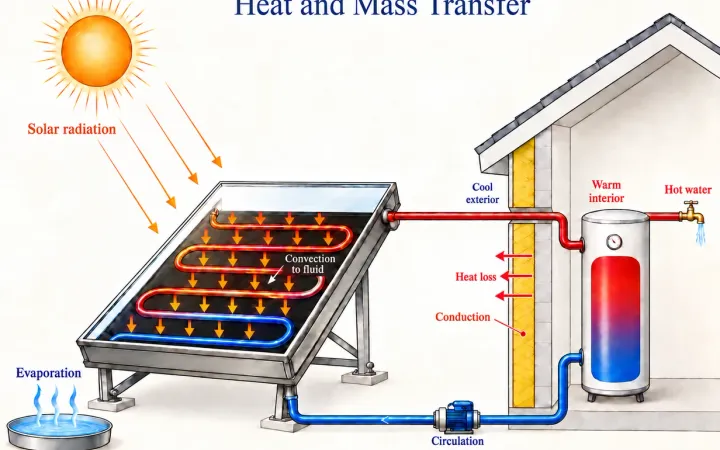
Course Content
ChaptersThe main purpose of heat transfer is to physically and mathematically model the energy transfer due to temperature difference. Conduction, convection and radiation mechanisms are introduced. The concepts of temperature field, heat flux, heat transfer rate, thermal resistance and energy balance are discussed. In this section, system boundary selection, assumption making and physical interpretation approach in heat transfer problems are emphasized.
Fourier heat conduction law, Newton's cooling law and Stefan–Boltzmann radiation law are examined as basic heat transfer mechanisms. Heat flux, temperature gradient, convection coefficient, surface temperature, ambient temperature and radiation properties are discussed in their physical meaning. The ability to establish energy balance for basic engineering problems involving conduction, convection and radiation is developed.
One-dimensional heat conduction in steady state is examined through plane wall, cylindrical wall and spherical geometry. Conduction, convection and contact resistance are interpreted together using the concept of thermal resistance; Series and parallel resistances, composite walls and critical insulation radius are addressed through worked examples and problem solving. In this section, the relationship between temperature difference, heat transfer rate and thermal resistance is evaluated in terms of engineering design.
The heat conduction equation is obtained by the differential energy balance approach and its physical meaning is interpreted. Temperature distribution in Cartesian, cylindrical and spherical coordinates, boundary conditions, time dependence and the concept of heat diffusion are discussed. Temperature distribution, maximum temperature and convection boundary condition worked examples and problem solving is studied in basic geometries such as plane walls, cylinders and spheres with internal heat generation. The engineering importance of internal heat production is interpreted through applications such as electrical heating, nuclear fuel elements and electronic cooling.
Finned surfaces are examined as elements that improve convective heat transfer by increasing the heat transfer area. The wing equation, temperature distribution, wing efficiency, wing effectiveness and different tip boundary conditions are addressed through worked examples and problem solving. Physical interpretation of the wing design is made through heat sinks, engine cooling surfaces and electronic cooling applications.
Time-dependent heat conduction problems are examined with stacked system analysis and transient conduction approach. The physical meaning of Biot and Fourier numbers, validity conditions of the lumped capacitance method, one-term and two-term approximation approaches, Heisler diagrams and the semi-infinite solid model are discussed. In addition, shape factor, superposition and basic solution approaches in two- and three-dimensional transmission problems are introduced.
Convection heat transfer is examined through the energy transfer between fluid motion and the surface. Velocity and thermal boundary layer concepts, laminar and turbulent flow structures, Nusselt, Reynolds and Prandtl numbers are discussed. The similarity between momentum and heat transfer, the physical meaning of the convection coefficient, and the basic logic of using correlation are explained.
Forced convection in external flow. It is examined through basic geometries such as flat plate, cylinder and sphere. Laminar and turbulent boundary layer, local and average Nusselt number, surface temperature and heat flux conditions are addressed by worked examples and problem solving. Emphasis is placed on the assumptions under which external flow correlations will be used and the physical interpretation of the results.
Forced convection in pipe and channel flows is examined through hydrodynamic and thermal development zones. Laminar and turbulent internal flow, constant surface temperature, constant heat flux, inlet length, average temperature and Nusselt number correlations are studied through worked examples and problem solving. In internal flow problems, the relationship between the bulk mean temperature change of the fluid, heat transfer rate and surface-fluid temperature difference is obtained by establishing differential or integral energy balance. Convection coefficient calculation is considered in heating and cooling applications.
Natural convection is examined through the density change caused by temperature difference and the flow caused by buoyancy force. Grashof, Rayleigh and Prandtl numbers. It is considered together with natural convection correlations for vertical/horizontal plates, cylinders and closed volumes. The difference between natural convection and forced convection and the selection of appropriate correlations are studied through worked examples and problem solving.
Heat exchangers are examined as engineering systems that provide energy transfer without direct mixing between two fluids. Parallel flow, counter flow and cross flow arrangements; Total heat transfer coefficient, fouling resistance are considered together with the LMTD method and the effectiveness-NTU approach. Heat exchanger performance, design parameters and energy balance worked examples and problem solving are studied.
Radiative heat transfer is considered as energy transfer through electromagnetic waves. The concepts of black body, gray body, emission coefficient, absorption, reflection, transmittance, spectral and total radiation are examined. Planck's law, Wien's displacement law, Stefan–Boltzmann's law and Kirchhoff's law are interpreted at a basic level and the effect of surface properties on radiation is studied.
Radiative heat transfer between surfaces is examined through shape factor and surface properties. Radiation exchange between black and gray surfaces, shape factor rules, radiation resistance networks and radiation shield concepts are discussed through worked examples and problem solving. The engineering importance of radiation calculation in ovens, solar radiation, high temperature surfaces and insulation applications is interpreted.
Mass transfer is considered at a basic level as the transport of matter due to concentration differences. Fick's laws, molar flux, mass flux, concentration gradient, diffusion coefficient and simple diffusion problems in steady state are examined. By establishing the mathematical similarity between heat conduction and diffusion, the basic mass transfer approach is studied with worked examples and problem solving.
Convection mass transfer, fluid motion and concentration are examined at a basic level through the boundary layer. Sherwood, Schmidt and Reynolds numbers. The mass transfer coefficient is considered together with the concentration difference and surface-fluid interaction. Simple evaporation, drying and surface mass transfer problems are interpreted using heat and mass transfer analogies.
Targeted Learning Outcomes
- Interpret conduction, convection, radiation and mass transfer mechanisms with their physical meanings.
- Solve continuous and time-dependent problems by establishing the heat conduction equation with appropriate boundary conditions.
- Choose appropriate dimensionless numbers, correlations and assumptions in forced and natural convection problems.
- Calculate performance in heat exchangers using energy balance, LMTD and efficiency-NTU approaches
- Analyze heat transfer through surface properties, shape factor and radiation networks in radiative heat transfer.
- Relate diffusion and convection mass transfer problems to heat transfer analogies.