

Engineering Mathematics
Engineering Mathematics is an applied mathematics course that addresses the mathematical background of advanced engineering problems through linear algebra, eigenvalue problems, Fourier–Laplace transforms, partial differential equations, complex analysis, conformal transformations and vector analysis.
Course Content
ChaptersThe concept of vector space, subspaces, linear independence, basis, dimension, span and linear combination concepts are discussed. How variables are represented in vector spaces in engineering problems and the role of linear structures in system modeling are examined. This chapter focuses on the physical and geometric meaning of abstract linear algebra concepts.
Matrix representations, linear transformations, matrix multiplication, inverse matrix, determinant, rank and linear equation systems are examined. By using Gauss elimination and Gauss–Jordan method, row echelon form and reduced row echelon form are obtained. The solution structure of homogeneous and non-homogeneous systems, free variables, rank interpretation and the geometric meaning of the solution space are studied together with engineering problems.
The concepts of eigenvalues and eigenvectors, characteristic equations and diagonalization of matrices are discussed. The physical meaning of eigenvalue problems is interpreted in engineering applications such as dynamic systems, vibration problems, stability analysis and mode shapes. In this section, how the linear system behavior is related to the eigenvalue structure is studied through worked examples and problem solving.
The concepts of inner product, norm, distance, orthogonality, orthonormal bases and projection are examined. The Gram–Schmidt orthonormalization method, the least squares approach, and the representation of functions in terms of orthogonal bases are discussed. In this section, orthogonality is linked to Fourier series, modal analysis and approximate solution approaches.
Fourier series are handled by representing periodic functions in terms of sine and cosine bases. Fourier coefficients, odd–even functions, half-range expansions and convergence behavior are examined. Fourier transform is studied in relation to frequency space, signal analysis, heat conduction, wave problems and spectral interpretation of engineering systems.
Laplace transform is considered as a transformation method used in solving initial value problems and linear differential equations. The concepts of inverse Laplace transform, fractionation, unit step function, impulse function and convolution are examined. Laplace approach worked examples and problem solving is used in mechanical vibration, electrical circuits, control systems and transient analysis.
By introducing partial differential equations, the heat equation, wave equation and Laplace equation are discussed in their basic forms. Problems with boundary and initial conditions are solved by using the separation of variables method. By establishing a connection with the Fourier series, the physical meaning of the solution in temperature distribution, vibration and potential problems is interpreted.
The concepts of complex numbers, complex functions, limit, continuity and complex differentiability are examined. Cauchy–Riemann equations, analytic functions, harmonic functions and geometric interpretation in the complex plane are discussed. In this section, the relationship of complex analysis with potential flow, heat conduction and area problems is established.
Curve integrals in the complex plane, path independence, Cauchy integral theorem and Cauchy integral formula are discussed. Integral properties of analytic functions and their behavior on closed contours are examined. In this section, the role of complex integration in potential theory, fluids and electromagnetic field problems is interpreted.
The local behavior of complex functions is examined with Taylor and Laurent series. Types of singularities, poles, removable singularities and essential singularities are discussed. Calculation of complex integrals and some real integrals is studied using the residue theorem. The advantage of this approach in engineering and applied mathematics problems is interpreted.
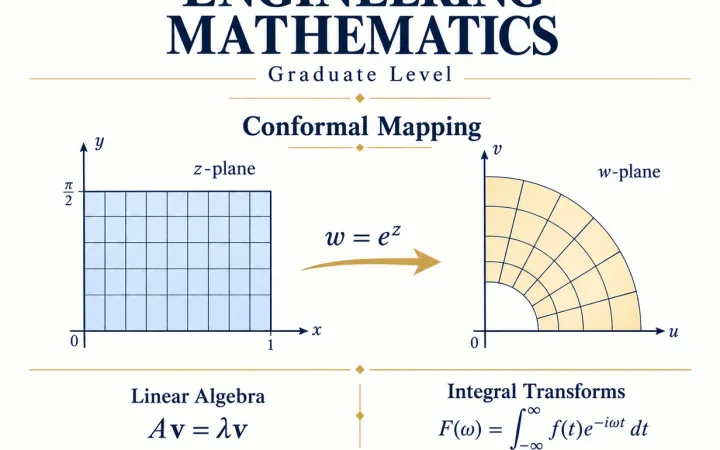
Conformal transformations are discussed through angle preservation property and complex plane region transformations. Simple transformations, Möbius transformations and the relationship with potential functions are examined. In this section, the role of conformal transformations in transforming complex geometries into more solvable regions in potential flow, electrostatics, heat conduction and boundary value problems is studied. Additionally, obtaining an airfoil profile from circle geometry via the Joukowski transformation and its relationship with potential flow problems are discussed.
Scalar and vector fields, gradient, divergence, curl, line integrals, surface integrals and volume integrals are covered. The relationship between local differential quantities and global integral expressions is interpreted through Green, Stokes and Divergence theorems. Velocity field, flux, circulation and vortex in fluid mechanics. In electromagnetism, applications are examined through electric-magnetic fields and field integrals.
Targeted Learning Outcomes
- Use linear algebra, eigenvalue problems and diagonalization concepts in mathematical analysis of engineering systems.
- Interpret series representations of functions by establishing relationships between inner product, orthogonality and Fourier series.
- Apply Fourier and Laplace transforms in differential equations, vibration, heat transfer and transient regime problems.
- Solve basic boundary value problems in partial differential equations by separating variables.
- Relate complex analysis, Cauchy's theorem, Laurent series, residue theorem and conformal transformations to engineering problems.
- Interpret vector differential and integral calculus tools in fluid mechanics, electromagnetism and field theory problems.