

Dynamics
Dynamics is a basic engineering mechanics course that examines the motion of particles and rigid bodies with kinematic and kinetic approaches, and covers Newton's laws, work-energy, momentum-impulse, angular momentum, rotation around a fixed axis, general planar motion, analysis on moving axes, Euler's equations and introduction to mechanical vibrations.
Course Content
ChaptersThe place of dynamics in engineering mechanics, its difference from statics, and the basic approach in modeling moving systems are discussed. The concepts of particle, rigid body, reference system, coordinate system, free body diagram, force, moment, center of mass and inertia are introduced. The physical meaning of the rigid body assumption and its role in idealizing real engineering systems are emphasized.
Particle motion is examined through position, velocity and acceleration vectors. Velocity and acceleration components are obtained in Cartesian coordinates, intrinsic, that is, tangential-normal coordinates and polar coordinates. The effects of curvilinear motion, linear motion, circular motion, relative motion and orbital geometry on acceleration components are studied through worked examples and problem solving.
In moving and rotating reference systems, the derivative of vectors with respect to time is discussed. Transport theorem, relative velocity, relative acceleration, Coriolis acceleration and the kinematic structure of the equations of motion in rotating axes are examined. In this section, how the particle motion defined on moving systems is observed from a fixed reference system is interpreted physically and mathematically.
The movement of particles under the influence of force is studied using Newton's laws of motion. Emphasis is placed on the free body diagram, choosing the appropriate coordinate system and establishing equations of motion. Force-acceleration relationship worked examples and problem solving is studied in linear, curvilinear, circular, tangential-normal and polar coordinate systems.
The concepts of work, kinetic energy, potential energy, power and mechanical energy are discussed through particle motion. Work–energy theorem, conservative forces, energy conservation and potential energy functions are examined through worked examples and problem solving. In this section, it is shown with an engineering interpretation when the energy approach is more practical instead of establishing a force-acceleration equation.
Linear momentum, impulse, momentum conservation and collision problems are discussed. The concept of angular momentum is examined through the relationship between moment and linear momentum relative to a point. Impulse-momentum equations, central force motion, impact effects and short-term force problems in particle systems are studied through worked examples and problem solving.
The motion of rigid bodies is examined through the concepts of angular position, angular velocity and angular acceleration. In rotation around a fixed axis, point velocity and acceleration expressions are obtained together with tangential and normal acceleration components. Kinematic relationships in pulleys, gears, discs, cylinders and related rotation systems are studied through worked examples and problem solving.
Torque, angular momentum and rotational equations of motion are discussed in rigid bodies rotating around a fixed axis. Mass moment of inertia, parallel axis theorem, calculation of moment of inertia in compound bodies and rotational kinetic energy are examined. Moment equation, work-energy and angular momentum approaches are applied through worked examples and problem solving in systems such as disc, cylinder, rod, pulley and flywheel.
General planar motion, in which rigid bodies perform both translation and rotation, is examined. Center of mass motion, angular motion, instantaneous center of rotation, relative velocity and relative acceleration methods are discussed. The condition of rolling without slipping is studied through disc, cylinder, pulley and wheel systems. This section emphasizes how translational and rotational motion should be modeled together.
Equations of motion are established using force, moment, center of mass acceleration and angular acceleration relations for rigid bodies performing plane motion. The equations ΣF = ma_G and ΣM_G = I_Gα; Rolling without slipping is applied on connected objects, pulley systems and moving elements. Work–energy and impulse–momentum approaches are extended to rigid body motion and studied through worked examples and problem solving.
Rigid body motion, defined in moving and rotating axes, is examined through systems in which translation and rotation occur together. Relative motion, rotating coordinate systems, the Coriolis effect, transported reference systems, and complex mechanism movements are discussed. In this section, how the velocity, acceleration and moment equations are transformed between a fixed reference system and a body-fixed reference frame is shown through worked examples and problem solving.
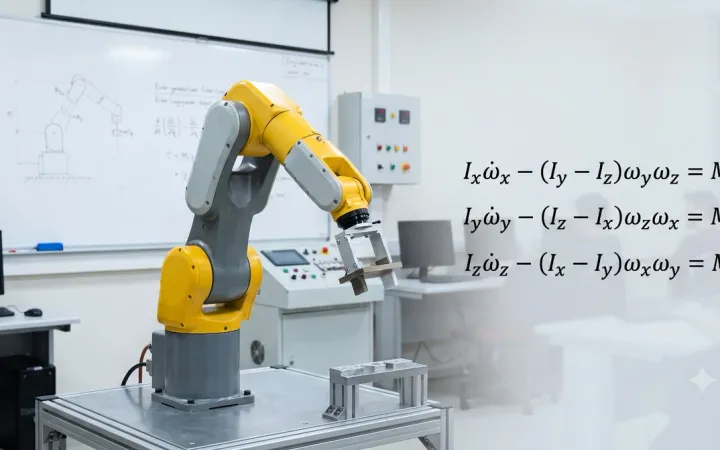
In three-dimensional rigid body motion, angular velocity vector, angular momentum, inertia tensor, principal axes and product moments of inertia are discussed at a basic level. Equations of motion and Euler equations are introduced for the body-fixed axes. Symmetrical objects, rotating disks, gyroscopic effects and two/three axes rotation problems are examined with engineering interpretation.
Within the scope of introduction to mechanical vibrations, single degree of freedom systems, mass-spring model, natural frequency, period, damping and forced vibration concepts are discussed. Free vibration, damped vibration, harmonic forcing, resonance and frequency response are examined at a basic level. This chapter shows how the approach to establishing equations of motion in the dynamics course connects to the mechanical vibrations course.
Targeted Learning Outcomes
- Model particle and rigid body motion by choosing the appropriate reference system and coordinate set
- Establish velocity and acceleration expressions in Cartesian, tangential-normal, polar and moving axes.
- Write equations of motion for particles and rigid bodies using Newton's laws
- Choose work-energy, energy conservation, momentum-impulse and angular momentum methods according to the appropriate problem type.
- Analyze moment of inertia, torque, angular momentum and rotational kinetics in rigid bodies rotating around a fixed axis.
- Establish the translation-rotation relationship in rigid objects that roll without slipping and perform general planar motion.
- Interpret principal axes, angular momentum and Euler's equations of motion in three-dimensional rigid body motion at a basic level.
- Use the concepts of natural frequency, damping and forced vibration at a basic level within the scope of introduction to mechanical vibrations.