

Differential Equations / Engineering Mathematics
Differential Equations / Engineering Mathematics is a foundational mathematics course that deals with mathematical modeling and solution methods of engineering problems through ordinary differential equations, initial value problems, series solutions, Laplace transform and linear systems.
Course Content
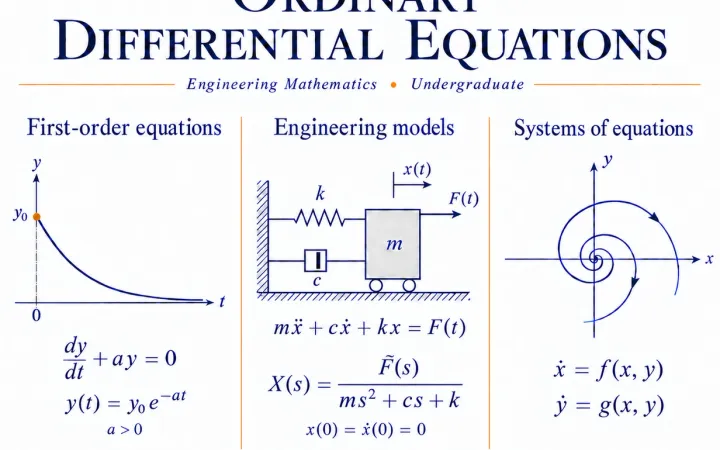
ChaptersFirst order ordinary differential equations; Separable equations, linear equations, exact differential equations, homogeneous equations and Bernoulli type equations are examined. By establishing initial value problems, solution constants are determined and the physical meaning of the solution is interpreted. Method selection is studied with growth-decrease, mixing, cooling and basic engineering modeling problems.
Second order ordinary differential equations with constant coefficients are discussed with their homogeneous and non-homogeneous structures. The general solution is obtained through the characteristic equation, real distinct roots, repeated roots and complex roots. Uncertain coefficients and parameter variation methods are studied through worked examples and problem solving; Physical interpretation is made through mechanical vibration and electrical circuit applications.
Higher order ordinary differential equations with constant coefficients are examined through the characteristic equation and the principle of superposition. The concepts of homogeneous solution, special solution, application of initial conditions and linear independence are studied. How higher order models emerge in engineering systems and how they relate to the root structure of solution behavior is interpreted.
In second order differential equations without constant coefficients, the series solution approach is considered. The solution structure is examined through the concepts of ordinary point and singular point, the power series method and the Frobenius method. In this section, in cases where the closed form solution is difficult, how the solution is represented by series expansion is studied through worked examples and problem solving.
Initial value problems are solved using the Laplace transform and the inverse Laplace transform. Basic transformation rules, transformation of derivatives, separation into partial fractions, unit step function, impulse/Dirac delta function and convolution concepts are discussed. Constant coefficient ODEs, piecewise defined inputs and time-dependent response of engineering systems are examined through worked examples and problem solving.
First-order linear differential equation systems are considered in matrix form. Eigenvalue–eigenvector method, homogeneous systems, forced systems, phase plane interpretation and stability analysis are studied. How multivariate systems are represented and solved by the differential equation model is examined through examples of mechanical, electrical and dynamic systems.
Targeted Learning Outcomes
- Recognize the types of differential equations and choose the appropriate solution method.
- Solve first and higher order ordinary differential equations using analytical methods.
- Transforming engineering problems into mathematical models using initial and boundary conditions
- Apply series solutions, Laplace transform and linear system methods according to the appropriate problem structure.
- Interpret the differential equation approach in engineering applications such as mechanical vibration, electrical circuits, heat transfer and dynamic systems.
- Establishing subject integrity before midterm-final, developing method selection and exam-type worked examples and problem solving skills