

Advanced Heat and Mass Transfer
Advanced Heat and Mass Transfer is a graduate-level engineering course that addresses multidimensional and time-dependent heat conduction, boundary layer-based convection, analytical/semi-analytical convection models in internal and external flows, spectral radiation properties, inter-surface radiation and basic mass transfer with an analytical, numerical and physical modeling approach.
Course Content
ChaptersThe concepts of energy balance, heat flux, temperature field and governing equation in heat transfer are discussed at an advanced. Conduction, convection and radiation mechanisms are interpreted within the framework of a common energy balance. Using nondimensionalization and scale analysis, we study how dominant physical mechanisms are determined, which terms can be neglected, and the physical meaning of characteristic dimensionless numbers.
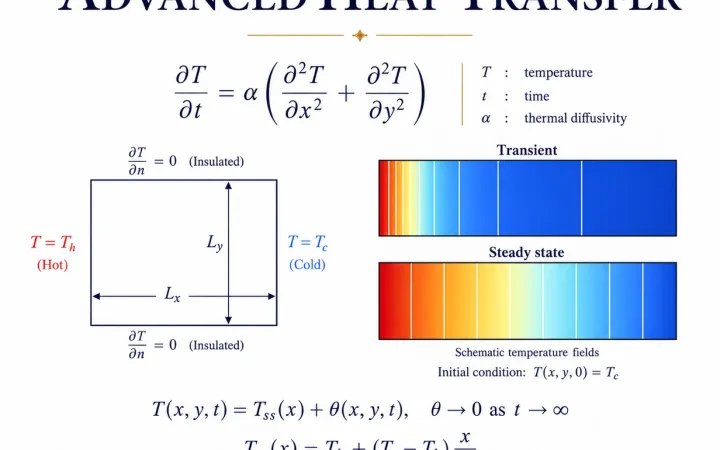
Two- and three-dimensional continuous heat conduction problems are examined through the heat conduction equation. Laplace and Poisson type problems are handled in Cartesian, cylindrical and spherical coordinates. In problems with homogeneous and non-homogeneous boundary conditions, the separation of variables method, eigenvalue problems, superposition and appropriate boundary condition transformations are used to solve problems.
Time-dependent heat conduction problems are handled with initial condition and boundary conditions. Using the separation of variables method, transient temperature field, eigenfunction expansions and time-fading modes are examined. Solution strategies for homogeneous and non-homogeneous boundary conditions, one-term and two-term approximation approaches are evaluated comparatively with the lumped capacitance method.
The numerical solution of the heat conduction equation is handled through the finite difference approach. Explicit and implicit schemes, space-time discretization, and the application of initial and boundary conditions to the numerical model are examined. The concept of stability is interpreted through the Fourier number, time step selection and physical/numerical behavior of the solution. In this section, the comparison of the analytical solution and the numerical solution is also studied.
Convection heat transfer is examined through velocity and thermal boundary layer equations. The continuity, momentum and energy equations are simplified under boundary layer assumptions. In external flow, the concepts of laminar boundary layer, momentum and energy thicknesses, Nusselt number and convection coefficient are handled with derivation logic. Emphasis is placed on the physical basis behind empirical correlations and the derivation of non-empirical fundamental correlations.
Heat transfer in laminar and turbulent external flows over a flat plate is studied with the boundary layer approach. Local and average Nusselt number relations are interpreted through similarity solutions, integral boundary layer methods and simplified forms of the energy equation. Constant surface temperature and constant heat flux cases are compared; Validity conditions and physical meaning of correlations are studied through worked examples and problem solving.
Hydrodynamic and thermal development zones in pipe and channel flows are discussed at an advanced. Temperature change and heat transfer are analyzed using the plug flow approach, fully developed flow, constant surface temperature, constant heat flux and energy balance. In internal flow problems, the relationship between bulk mean temperature, wall temperature, convection coefficient and Nusselt number is studied by derivation and worked examples and problem solving.
Natural convection is examined as flow caused by density change caused by temperature difference and buoyancy force. Basic relations are obtained through the Boussinesq approach, Grashof and Rayleigh numbers, natural convection boundary layer and scale analysis. Natural convection problems in vertical plates, horizontal surfaces and closed volumes are evaluated in terms of physical modeling and correlation selection.
In radiative heat transfer, the concepts of black body, gray body, real surface, spectral emissivity, absorptivity, reflectivity and transmissivity are discussed. Planck's law, Wien's displacement law, Stefan–Boltzmann's law and Kirchhoff's law are examined with their physical meanings. Calculation of emissivity and absorptivity values from spectral distribution graphs, integral approach for stepped and non-uniform distributions and use of blackbody radiation fraction are studied through worked examples and problem solving.
Radiative heat transfer between surfaces is examined through irradiation, radiosity, form factor and radiation resistance networks. Radiative exchange between black and gray surfaces, shape factor rules in closed volumes, multi-surface systems and radiation network model worked examples and problem solving are studied. The use of radiation shields, the effect of the number of shields on heat transfer, and radiation reduction strategies in high temperature engineering applications are discussed.
Mass transfer is handled at a basic level through the concepts of concentration difference, molar flux, mass flux and diffusion coefficient. Fick's laws, steady-state one-dimensional diffusion and simple convection-diffusion equations are examined. By establishing the mathematical analogy between heat conduction and diffusion, basic mass transfer problems are studied with a physical interpretation.
Mass transfer by convection is examined at a basic level through the concentration boundary layer and fluid movement. Analogies between heat and mass transfer are discussed using Sherwood, Schmidt, Reynolds and Lewis numbers. Appropriate model selection, use of correlation and physical interpretation are studied for simple evaporation, drying and surface mass transfer problems.
Targeted Learning Outcomes
- Correctly establish the governing equation, boundary condition and initial conditions in multidimensional and time-dependent heat conduction problems.
- Solve transmission problems with homogeneous and non-homogeneous boundary conditions with the separation of variables approach.
- Compare analytical solution, approximate solution and numerical solution approaches in time-dependent heat conduction problems.
- Interpret the concept of stability and the effect of time step selection on the solution in finite difference based heat conduction solutions.
- To understand how to obtain non-empirical basic relations in transport problems based on boundary layer equations.
- Analyze temperature distribution and heat transfer using plug flow, fully developed flow and energy balance approaches in internal flow transport.
- Interpret the radiation behavior of surfaces using spectral radiation properties, emissivity, absorptivity and Kirchhoff's law.
- Analyze the effect of shape factor, radiation networks and radiation shield in inter-surface radiation problems.
- Relate basic diffusion and convection mass transfer problems to heat transfer analogies.